
Hijacked by Fiction
A conversation between Alice Heyward and Harrison Ritchie-Jones
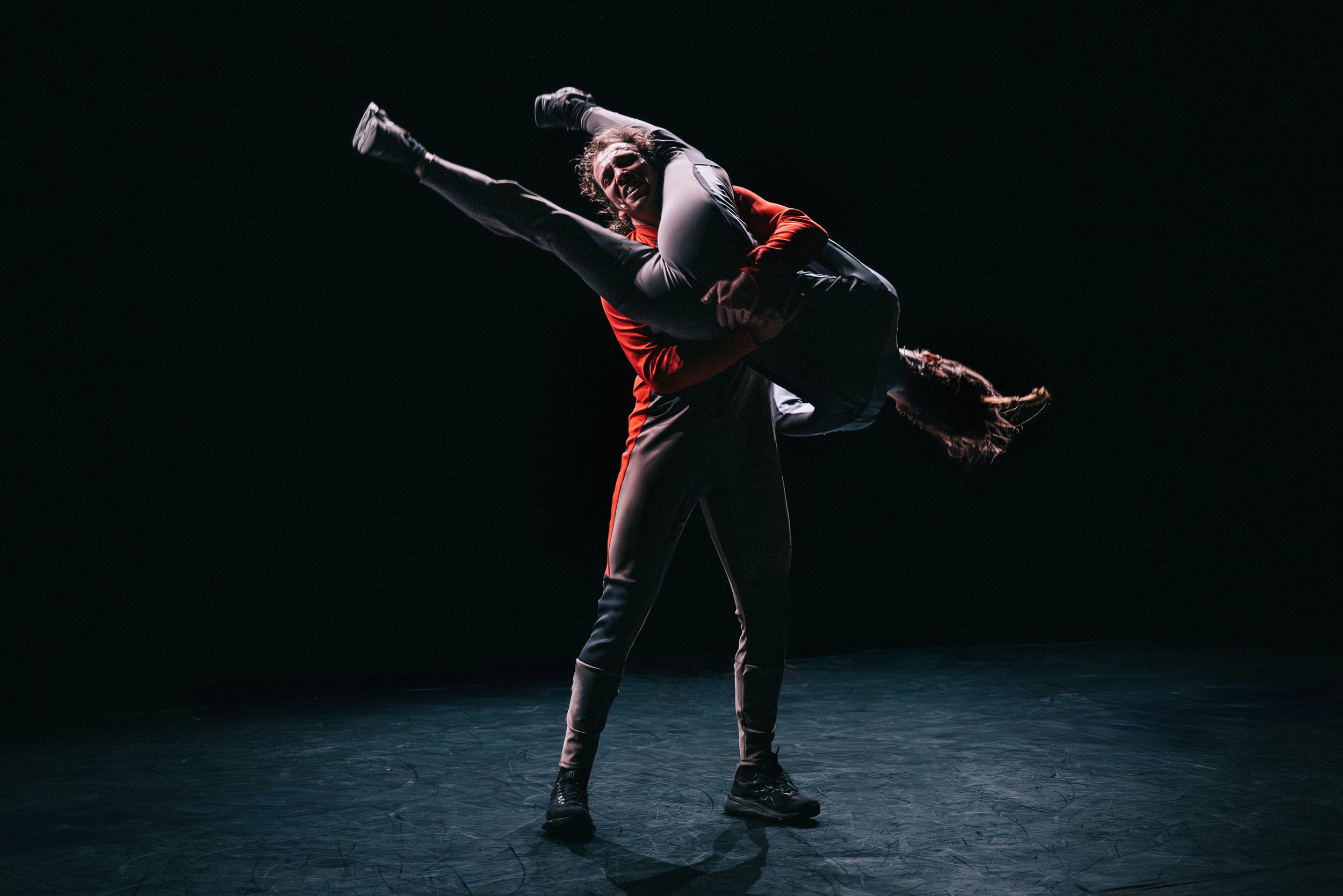
R.A.I.N, Image by Darren Gill
Harrison Ritchie-Jones has an ongoing creative relationship with Chunky Move. He performed in Antony Hamilton’s works Token Armies (2019) and 4/4, which premiered at Malthouse Theatre in 2023, before touring the work throughout Europe with the company in 2024. In 2023, his work Cuddle, performed in collaboration with dance partner Michaela Tancheff, was presented by the company as part of FRAME. In 2025, he showcased R.A.I.N at Chunky Move Studios alongside Tancheff.
This conversation took place almost six months after Alice saw Tantrum for 6 at Northcote Town Hall Arts Centre (Darebin Arts) in February 2025, and immediately following Harrison’s second of two performances of R.A.I.N at Chunky Move on August 29, 2025. (Alice did not see the work.) Soon after, Harrison went on to create Pigeon Humongous for Sydney Dance Company’s New Breed commission program (November 2025).
Alice Heyward:
You just made and performed a show in ten days!
Harrison Ritchie-Jones:
I had to prove I could do something that crazy. I’m proud we did, but I’d never choose this. Time is a crucial ingredient in making work — even the space between developments matters. There are hardly any development grants anymore, and everything needs an outcome. This climate shapes what’s possible.
When you have less time, there are two simple paths: you choose what you know, or you try to push outside of that. The second is more uncomfortable, more vulnerable. R.A.I.N was an opportunity to challenge my practice and push it into new places — maybe a bit more serious, more undercut. I used the short time frame as an experiment.
It was super chaotic, and it went really well. There were so many conversations — music, lighting, costume — and I’m performing as well as choreographing the work. We sold out, and the reception was buzzing. Someone even said it was their favourite work they’d ever seen me make, out of Cuddle, Tantrum for 6, Cold Tooth, Big Wig Small Gig, and some pop-up performances.
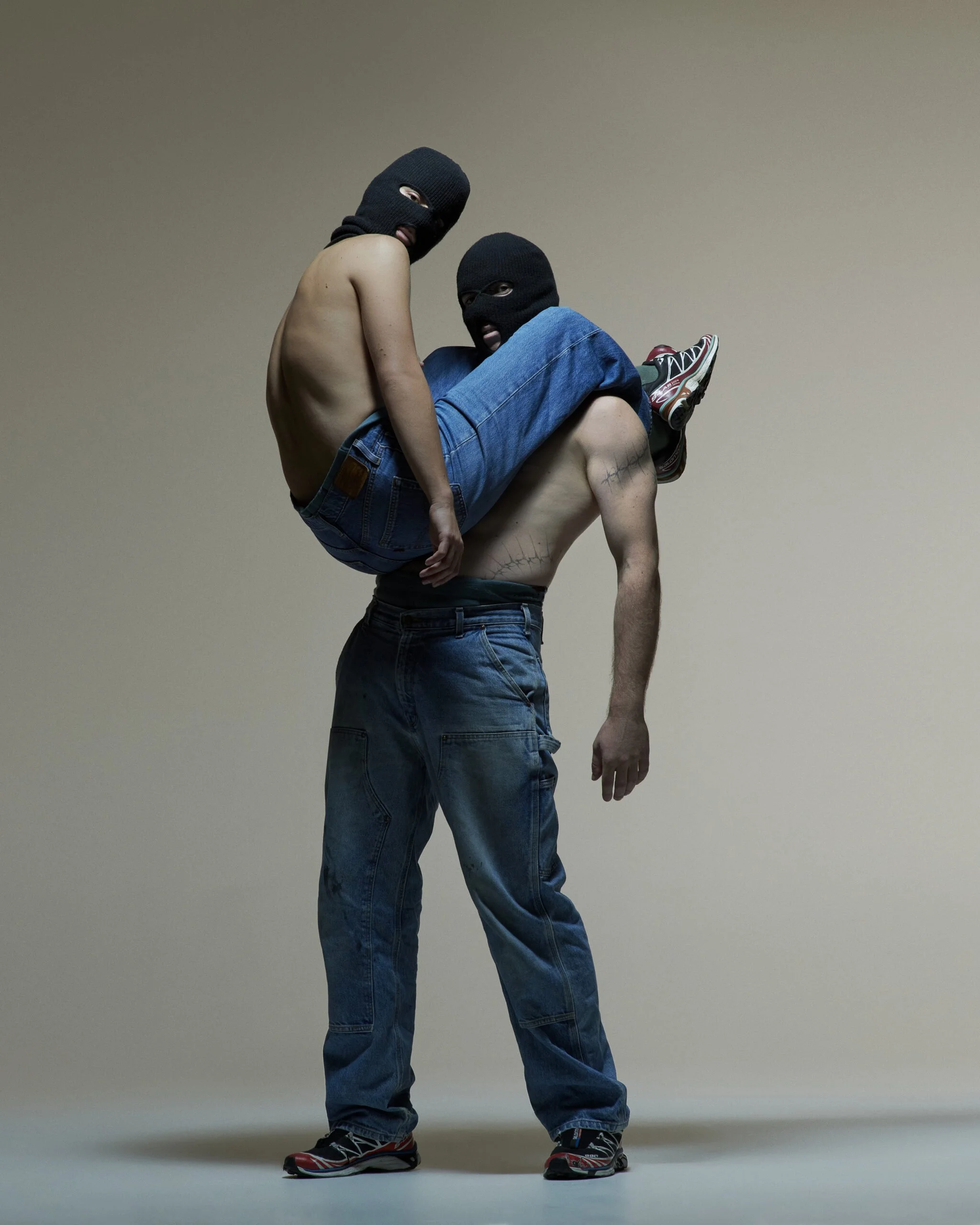
Cuddle, Image by Jo Duck
Alice:
What does R.A.I.N stand for?
Harrison:
It comes from Tara Brach’s meditation practice: Recognise, Allow, Investigate, Nurture. It started as a funny prompt to think about movement without judgment. Michaela (Tancheff, collaborator) was obsessed with the meditation; I resisted it.
Then something really meta happened. R.A.I.N became a way of analysing the process itself — recognising discomfort, allowing it, investigating it. Tara Brach’s voice ended up in the work. I edited her meditation to make it sound more sinister. Instead of expansive prompts, it became clipped: “Something’s wrong.” I butchered the guru.
Alice:
There are so many imperatives in the language of guided meditation. It can be violent. That submission is something to reckon with. Sounds like you played with that power dynamic…
Harrison:
When I meditate, I get distracted: I go on tangents, then return to my breathing. The work does this too. It returns to a meditative dance but keeps getting hijacked by fictions — opera screaming, pop singing, satanic movie references.
Then it comes back to the metronome and Tara’s voice. It’s a meditation that includes cycles of distraction, darkness, and returning.
Alice:
The fictions surface and pass.
Harrison:
Exactly. They play out — like a spaghetti western — and then suddenly we’re back, dancing. I was interested in pushing the partnering language I’ve been developing far enough that it could wash up inside fiction. For the audience, you don’t see scenes change; before you realise it, you’re suddenly inside something.
Alice:
Like a dream.
Harrison:
Exactly. You’re not observing it from the outside — you’re inside it.
Alice:
Sounds psychedelic. And unlike in solo meditation, performing with Michaela feels integral to this very relational way of getting lost and returning.
Harrison:
R.A.I.N couldn’t exist without her. We revisited everything — old places and new ones — like a quest.
Alice:
It’s not the first thing you’ve made together, right?
Harrison:
We made Cuddle together — that was really the inception of this partnering language. She’s been there, part of a lot of my works since then.
Alice:
There’s something paradoxical about the precision and chaos of partnering. Bringing two things together is such a simple, formal equation, and chaos emerges through tension.
How do you relate to recognised, established partnering forms, like Contact Improvisation? It’s always been funny to me that Steve Paxton is credited as the father of Contact Improvisation — attributing an inherently collective practice to one individual.
Harrison:
I’ve had a lot of partnering training — martial arts, Latin dance, ballroom, salsa, swing. Early on, especially around Cuddle, I was really studious: watching ice skating, rodeo, clipping movements, and analysing their logic.
Over time, the overlaps became more interesting than the references — momentum, suspension, intention. Some forms are submissive, some graceful, some technical, some expressive. I pushed those overlaps until the distinctions became really small. Now the movement can feel equally aggressive and incredibly sensitive. The gnarlier it looks, the more care it requires.
We learn pathways, then abandon them. You have to know something deeply to fuck it up properly. We’re not improvising, but following the energetic memory of structures.
It’s like entering a shared world that’s physical, cerebral, and emotional, with its own dramaturgy. That takes time. It’s not just noodling around.
Alice:
Have you thought about teaching this practice to others?
Harrison:
We ran a partnering workshop recently. The basics translate easily — principles like three-legged walking and shared balance. But R.A.I.N couldn’t have been made by anyone other than Michaela and me. We improvise at the end, and it’s highly specific and virtuosic, but only because of years of working together.
I’m curious how this language transfers to other bodies. For New Breed, I want to bring some of this in, but the incubation time is short, and the work is made with a larger group.
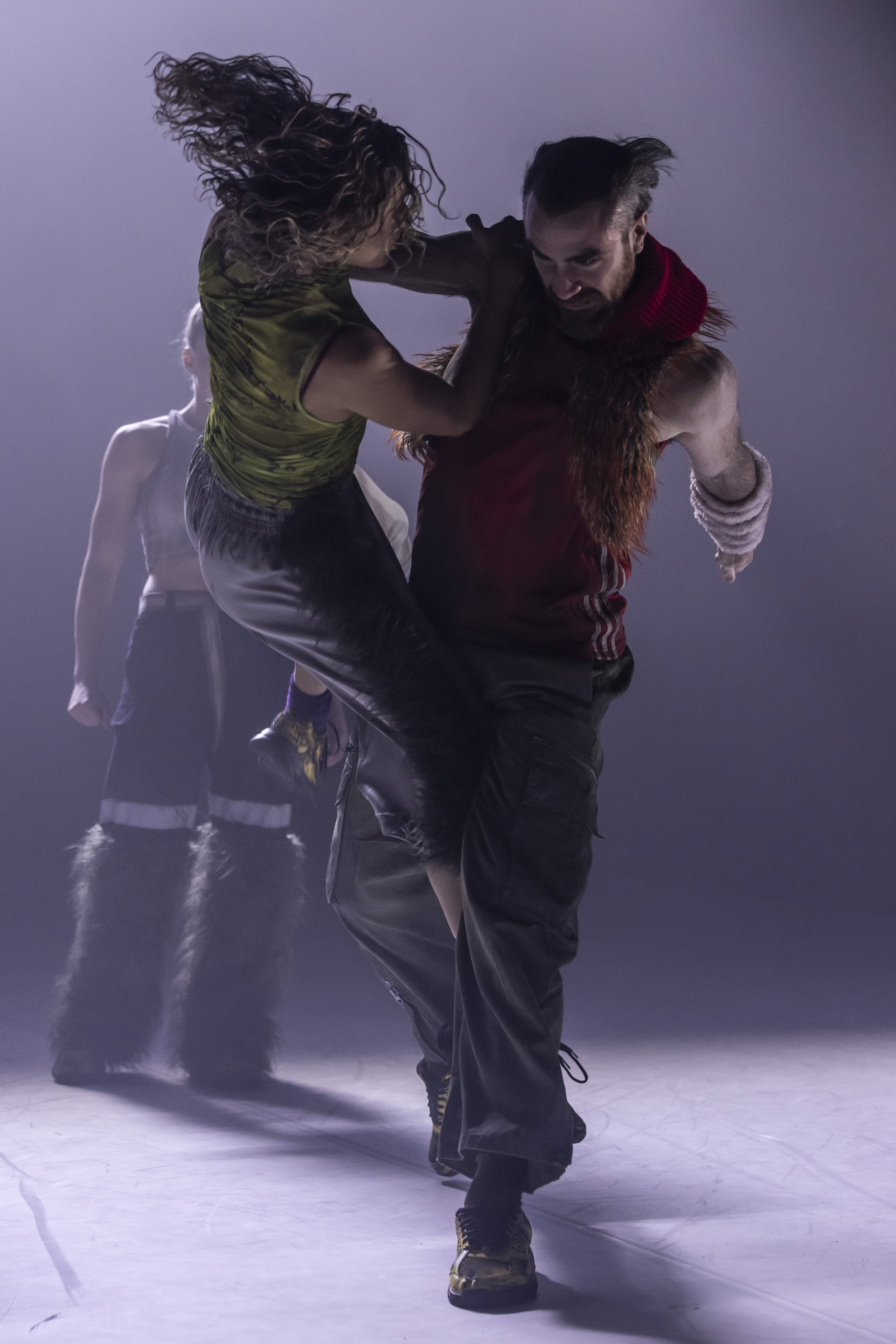
Pigeon Humongous, Image by Pedro Greig
Alice:
You can’t just transmit that same quality of a practice developed between particular people over a long time, on demand to others. Time and conditions shape what’s possible to produce.
Harrison:
Exactly. It’s a neoliberal fallacy that you can. Michaela is integral to my practice, and she’ll come to Sydney Dance Company with me to work with the dancers.
Alice:
How was it for you to return to the duet format after Tantrum, a group work?
Harrison:
Cuddle was also a duet. Then I did Big Wig, which was three. Tantrum was six. It was nice to go back to two. And the more I make, the more I see patterns and obsessions resurfacing in every constellation.
The cycle of making work is like the cycles in an improvisation. The first three minutes feel infinite. Then ten minutes later, it feels like there’s nowhere to go. And then suddenly it feels infinite again.
Alice:
We’re constantly bouncing between what we do and don’t know about what we’re doing. You have to keep experimenting — not knowing the outcome — to keep returning to the unknown. Problem posing and holding, not solving.
Harrison:
Crystallising something intuitively. I usually stick to one fiction or world and expand from there, like the baby world in Tantrum. R.A.I.N is more like a fractured mirror, made up of shards of other works. That was the challenge: not sitting inside one thing.
I think the work speaks to subtle experiences we all share — internal dialogue, impulses, friction, ease.
Alice:
I’ve been noticing a lot of interest among artists (of our generation) in embodying “the baby” or “the child,” or the teenage liminal space — cuteness, quinceañera rituals, feminine explorations of girlhood. I saw Baby Choir by Suvi Kemppainen + Josefine Mühle in 2021; my friends Luisa and Estephania are developing Quinceañeras; there’s Hanako Hayakawa’s Yugi 遊戯 — and your Tantrum. Across the contexts and cultures that ground and form these projects, is there a shared nostalgia for lost innocence? What questions opened Tantrum?
Harrison:
I was more interested in a child's logic than in de-aging myself. I love how children experience and express multiple emotions in quick succession — terror, crying, laughter — without rationale or censorship. Applying that to partnering is fascinating.
What happens if you’re dancing and suddenly fall backwards, or cry, or laugh? It creates layers of reading: the relationship, someone’s upset, someone’s nasty. It becomes a lasagna of dramaturgy.
Alice:
There’s no shame, no prescribed morality yet...
Harrison:
Exactly. No concept of consequence. That abandonment is instinctive and pure. You don’t judge a child for crying. But if an adult cries in a supermarket, it’s taboo. That filter creates a huge shift in how things are read.
Alice:
I noticed how audience laughter functioned in Tantrum, becoming part of our shared soundscape. People seemed eager to share their feedback in the theatre by laughing at every uncanny occurrence.
Harrison:
That happens a lot. I never set out to make funny work, but people still laugh. It took me a while to accept that. Tension creates humour. Discomfort creates laughter. People tell me they wanted to cry but were laughing. Something strange is happening there.
Alice:
Maybe a way of adults managing not knowing what’s going on, in ‘public‘ — a coping mechanism tied to the collectively anonymous position of being a spectator in the theatre, reaching for recognition in the dark.
How did you set up the theatre for R.A.I.N at Chunky Move?
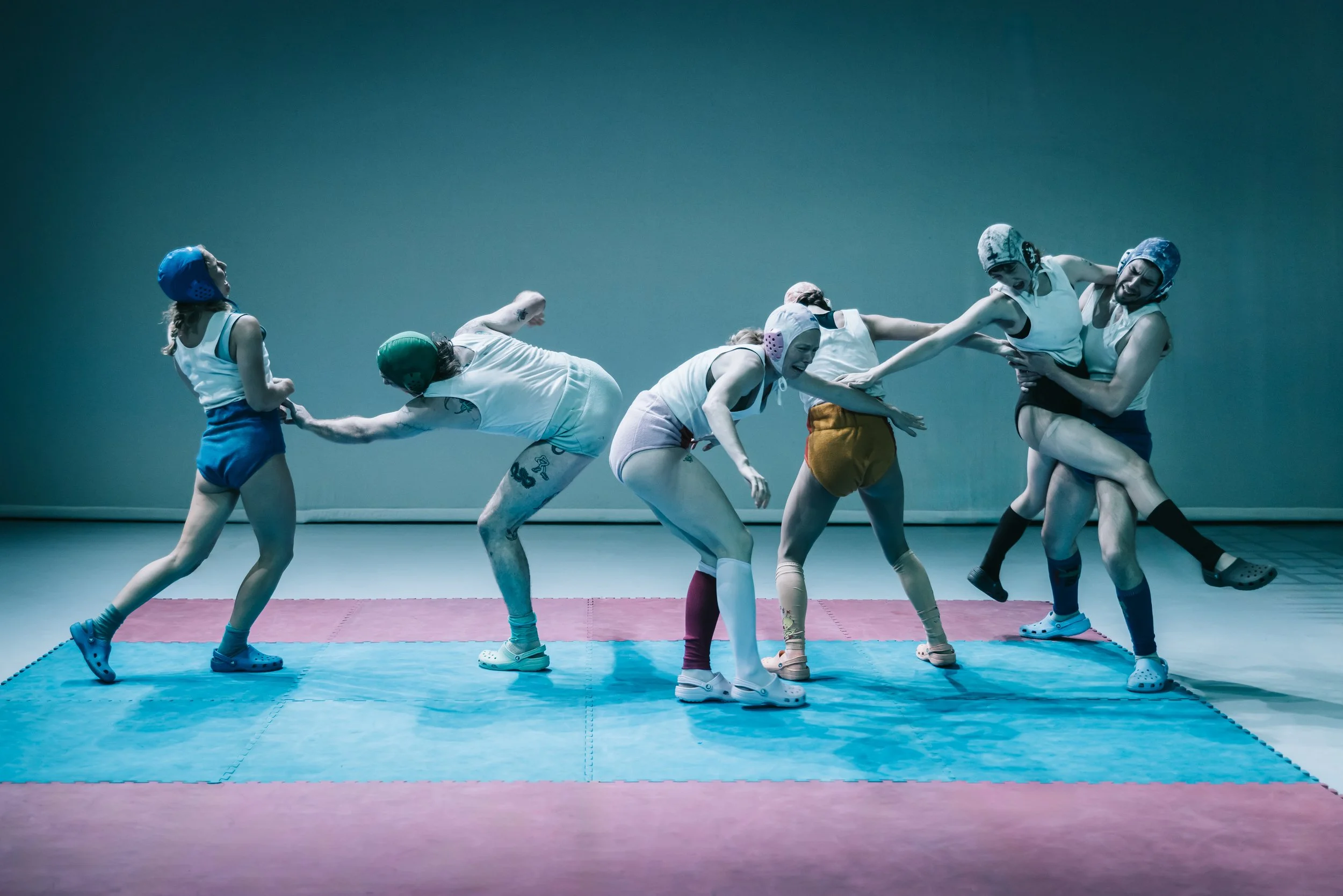
TANTRUM for 6, Image by Darren Gill
Harrison:
I did something more conventional, with a seated bank. I usually change the orientation immediately, entering from behind the audience or through corridors, or by working with film. But this time I wanted to see if the work could cope without those destabilising devices.
I’ve been working a lot in galleries and site-based contexts. The challenge was actually to do the obvious thing here. Tantrum had film and three cycloramas. R.A.I.N felt bare without a cinematographer punching in on detail. I had to ask: how do I show detail without the camera?
Alice:
You’re also working a lot as a dancer in other people’s work. How does that sit alongside making your own?
Harrison:
It’s intense — door to door. Dancing nine to five, then making your own work on top. But dancing in others’ work is a gift. You stay in your body. You learn.
Recently, while working with Jo (Lloyd), I had a shift—really understanding what it feels like to be on the other side of the creation process. My questions changed. I wanted to support her decision-making, not just offer ideas.
Alice:
That’s active lineage!
Harrison:
Exactly. Ghosts in the room. You carry people with you — not by copying them, but by letting their instincts inform yours.
Alice:
Do you want to tour internationally?
Harrison:
Export is really hard right now. Independent work is lighter, but harder to place. Australia is geographically isolated. But new contexts would change how the work is read. If I showed R.A.I.N in Berlin, for example, no one would know my previous work. That changes everything.
Alice:
Audience context shapes making — and performing.
Harrison:
Totally. You only get a first encounter once.
Alice Heyward is an Australian dancer-performer, choreographer, dramaturge, writer and teacher based in Berlin. Her work explores movement-thought, embodied poetics, and collaborative practice through dance, choreography, performance, text and pedagogy. She writes monthly for Tanzschreiber (TanzBüro Berlin) and is published widely on platforms such as Spike Art Magazine, Berlin Art Link and PW Magazine, contributing essays, interviews, and critical reflections on contemporary performance. Her choreographic work is presented internationally, and she performs with leading artists across dance and visual art contexts. Heyward is a certified Klein Technique™ teacher and regularly teaches movement and dance across professional studios, universities, and research environments. In 2026, she's performed Tirana by Luisa Saraiva at SESC Belenzinho (São Paulo), and will soon perform Étoile Allergique by Shade Therét at TanzQuartier Wien and Temporary Title, 2026 by Xavier Le Roy at Palais de Tokyo (Paris). 2026 will also see the publication of Protecting Existence, questioning 'performance conservation', and Transmission As Formation for Tracing Australian Contemporary Dance: Artists, Archives, Making Histories, a new, peer-reviewed book on Australian Dance published by De Gruyter Brill in Germany.
Harrison Ritchie-Jones is an award-winning choreographer, dancer, and filmmaker whose work is making waves with his eclectic, unconventional approach to dance. Clashing forms and styles with high technical skill, he uses dance as a frame for absurdity, physical virtuosity, and surreal storytelling. Based in Naarm/Melbourne, Australia, he has presented his works in a diverse range of settings across Australia - from black box theatres to town halls, from white box galleries to nightclubs. As a choreographer, he has been commissioned and/or presented by organisations across Australia, including Lucy Guerin Inc, Sydney Dance Company, Stephanie Lake Company, Strut & PICA, RISING Festival, Dark MOFO Festival, MONA, Gertrude Contemporary and Melbourne Fringe Festival. Much in demand as a dancer, he has worked regularly with most of Australia's leading choreographers, including Stephanie Lake, Antony Hamilton, Jo Lloyd, Lucy Guerin, Melanie Lane and Alisdair Macindoe.