
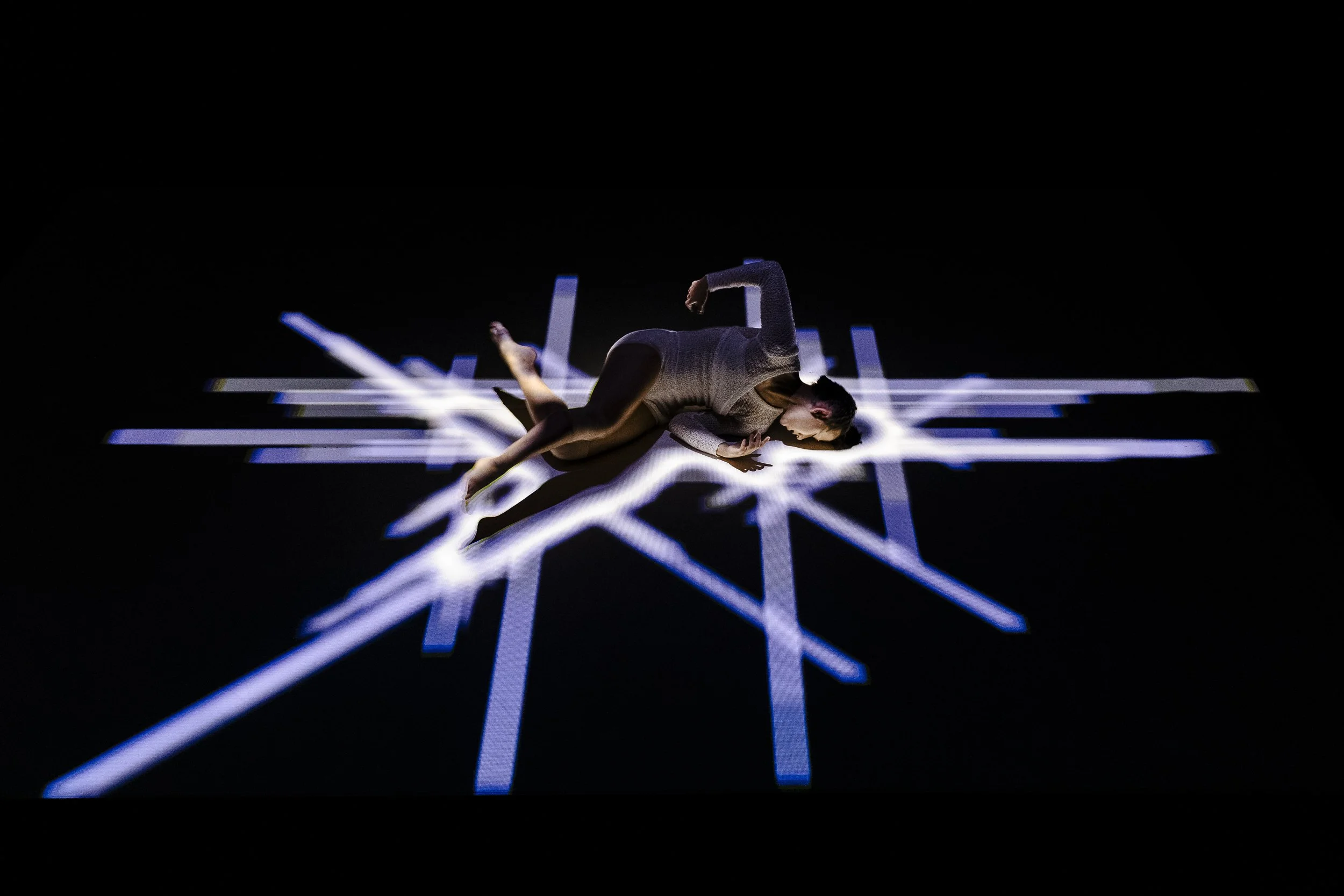
Image by Gianna Rizzo
To return to a performance after two decades is to encounter a peculiar kind of temporal displacement. When Glow premiered at the Melbourne International Arts Festival in October 2006, it was quickly catalogued by a wave of critical consensus as a breakthrough in interactive design and a landmark solo that tethered the human form to an unyielding matrix of light. By the time the work arrived in October 2007 for the Adelaide Festival's About Time program, where I first sat before it as a child, the work had already begun constructing its own mythology. In 2026, during its anniversary season presented in Chunky Move’s main studio for RISING and the inaugural Australian Dance Biennale, I found myself sitting before the work once more—this time, on three separate occasions—witnessing three distinct generations of bodies (original cast member Sara Black, alongside Layla Meadows and Melissa Pham) inherit the same historical, twenty-seven minute choreographic lineage. The software artist Frieder Weiss flew from Germany to calibrate the machine once more. The original infrared video camera and Kalypso tracking system were booted up; the small, white rectangular tarkett was rolled out in the centre of a raked seating bank in the round.
But what exactly is enacted by the decision to re-stage a historically heavily toured work? What weight is given to a relic when it is platformed two decades later, and what happens to the choreography when the future it once predicted has already become our banal, over-documented past? Whose memories are being kept alive by this rebooted software, and how do we reconcile the labor spent in maintaining a monument with the deep, generative exchange that occurs when a lineage is passed down? To view the remount purely as an extraction of bodily capital is to miss the complicated generosity of the studio. The act of restaging is a dual movement: it is a demand placed upon the body, but it is also a profound offering of embodied knowledge, an invitation for a new generation to receive, test, and inhabit an ancestral physical architecture.
In dance history, this re-performance of canonical solo and ensemble works has long functioned as a sacred rite of passage—a mechanism of survival rooted in deep pedagogical sharing. We see it in the rigorous, generational handovers of Pina Bausch’s repertoire or the fiercely guarded precision of Anne Teresa De Keersmaeker’s Rosas danst Rosas. In classical ballet, the recycling of choreography is passed down like oral history, a physical inheritance that demands the dancer become a living archive while granting them a foundational material literacy. Yet, Glow presents a more complicated preservation because its choreography is co-authored by an engineering framework. It earned its title as the most widely toured Australian contemporary dance work by virtue of its logistical nimbleness. Operating with just one dancer, a data projector, an infrared camera, and a PC, it carried its specific biotech fiction across five continents and more than 40 cities. Is a work truly being preserved if it relies on proprietary rights to stay alive? What happens to a dance when its notation is written in code that faces obsolescence, and the act of sharing must contend with a collapsing digital infrastructure?
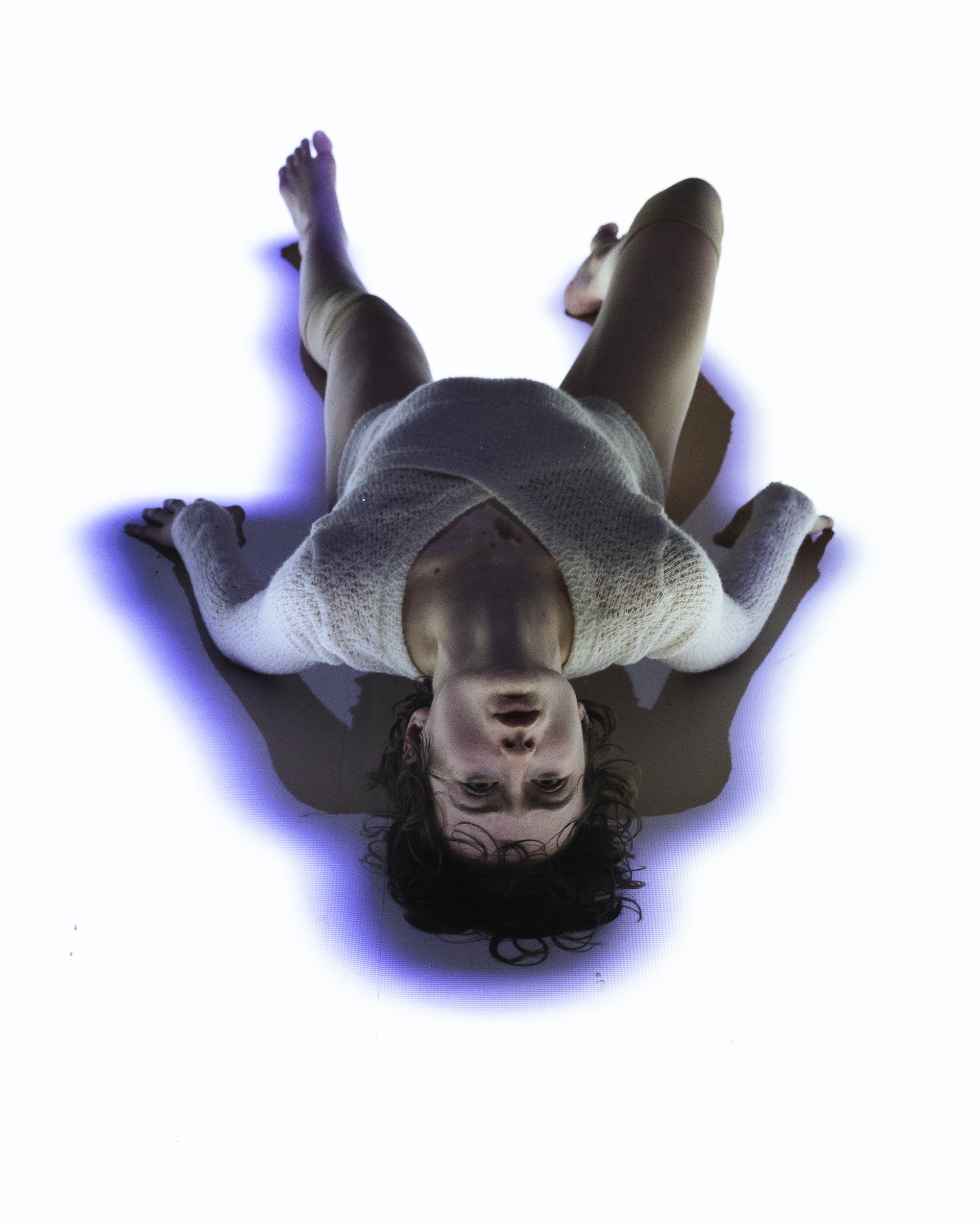
To look at Glow in 2026 is to see a work whose technological radicalism has mellowed into a low-fi, historical appeal. The interactive motion graphics no longer read as the seamless vanguard of tomorrow; instead, their stark, uncompressed aesthetic carries a distinct material weight that contrasts sharply with our current era of hyper-saturated, smoothed digital interfaces. There is an elemental clarity to this older system that continues to grip contemporary audiences. The movement itself carries the distinct markers of early 2000s Australian contemporary choreography, defined by relentless, joint-compromising floor work, and the hyper-specific, broken aesthetic of a sickle foot. This deliberate choreographic inversion of classical line firmly anchors the work to its era.
Lebanese-American poet and painter Etel Adnan, when writing on the architecture of illumination, contends that "Light is a presence. It is a presence that can be modulated, but never entirely tamed." In Glow, the light is not a passive spotlight; it is an active, tracking gaze that behaves like a retinal imprint or the permanent burn-in on an old CRT monitor. Much like the way human eyes retain a glowing, phantom afterimage after staring into a bulb, the software carries a stubborn, material memory of the forms it has monitored across its long touring history. There are moments when the projection falls out of step with the performer, seen as lagging behind or ghosting her lines. In these brief, intentionally uncalibrated lapses, the light reveals its own internal time, leaving a heavy, luminous stain on the tarkett like a physical memory refusing to dissolve.
The sonic architecture of the piece works in tandem with this visual confinement to isolate the performer. Luke Smiles and Ben Frost’s score historically constructs the deep claustrophobia of this space, thick with low-slung, industrial hums, heavy bass flutters, and abrasive, processed drones that vibrate through the marrow of the audience. The sound design successfully seals the white rectangle, transforming the crisp geometric boundary into a closed acoustic chamber from which there is little escape. Yet this digital enclosure is consistently ruptured by the body itself; from the dark, the dancer emits demonic, guttural and non-linguistic vocalisations. These unsettling sounds, it is later revealed, are sentences learned backwards, delivered as if in a state of somatic possession. Managed from the console by multimedia operator Nick Roux, the real-time tracking system and the acoustics lock together, ensuring that the performer's fractured voice and frame remain trapped within an inescapable, bio-technological feedback loop.
The work is structurally bound to a flat plane, a deliberate spatial choice that enforces a complex, multi-layered regime of horizontal labour. Historically, modern dance positioned floor work as a paradigm of release and radical resistance, an embrace of weight and gravity that explicitly opposes the disciplinary, upward verticality and disciplined militancy of classical ballet. On the tarkett, the floor offers a supportive surface, yielding a structural space of reprieve that is, nonetheless, complicatedly tinged with submission. Because of the overhead interactive projection, this horizontality is re-scripted; it is impossible not to read the performer as pinned down, tracked in the beam of an algorithmic apparatus that transforms the floor into a site of containment. This flattening serves an existential purpose; it frames the performer as an embryonic organism struggling against a surface that simultaneously holds and monitors them. The narrative arc mimics a grotesque metamorphosis, an evolution that recalls the body-horror biology of Ridley Scott’s 1979 cult classic Alien. We watch the lifecycle of a new kind of cyborg, tracing its trajectory from the strange beauty of a "supernaturally, sparkling foetus" through an "adolescence of logic and lines," toward a terrifying fracturing of the self.
When the dancer finally stands, the shift is seismic. It is not an act of triumph, but a crisis of possession. Here, the interactive system begins to generate Rorschach-like digital blotches and independent shadow figures expelled from the performer's flesh. The body becomes a host for its own digital echoes, shifting the performer away from a stable humanity and into a fractured, non-human state where the physical form must negotiate with its own monstrous double. By mirroring the symmetry of the psychological inkblot test, the Kalypso software behaves as a real-time diagnostic apparatus. It reads the organic lines of the flesh and instantly projects them back as externalised, haunting stains. It is a visual staging of paranoia, a psychoanalytic splitting in which the self is multiplied, analysed, and haunted by its own traces within an animated habitat.
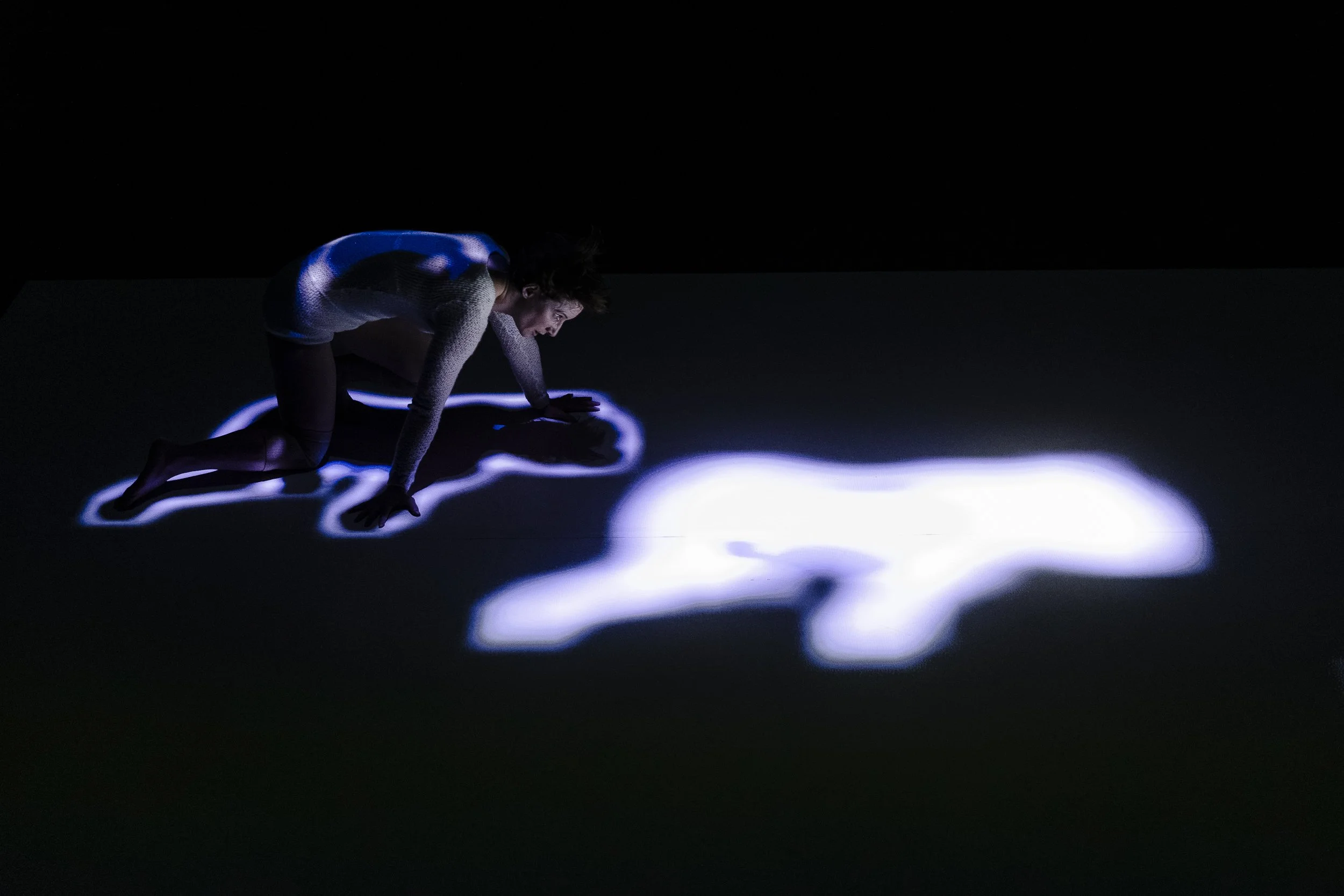
Watching this exorcism, I find myself mapping the dancer’s entrapment against the trans philosopher and writer Paul B. Preciado’s provocations on institutional containment and somatic rebellion in Can the Monster Speak? When delivering a lecture directly to an international academy of psychoanalysts, who viewed his transness as a structural anomaly, Preciado famously spoke from the position of a self-reclaimed "monster" to dissect the violent, pathologising gaze of the clinic. There is an unexpected but vital parallel here: just as Preciado stands before the academy to seize control of the discourse surrounding his own diagnosis, the dancer in Glow stands within the digital frame, turning the tracking regime into a platform of open confrontation.³ The body functions as a platform of inscription, a site where the machine inscribes, yet the human flesh continuously threatens to leak outside the pre-programmed borders of the inkblot. Preciado’s philosophy prompts me to consider this algorithmic architecture not as a permanent reality, but as a temporary architecture of control that can be actively dismantled through the sheer friction of presence. Can the monster speak from within the grid? Can the body ever truly separate itself from the diagnostic technology that records its existence, or are we always already caught in its loop?
As the exhaustion sets in and the digital shadows threaten to entirely overwhelm the flesh, another of Adnan’s considerations on illumination could here offer a way out. She reminds us that "the day is not made of light, but of will." The climax gives way to a rinsed, punishing final section where physical fatigue takes over. Here, the dancer’s sweat and laboured breath break the clean, mathematical perfection of the tracking system. This cleansing process is driven entirely by the performer's internal determination to outlast the machine, executing a final, exhaustive effort to wash away the digital skin before the projector and stage lights abruptly terminate, leaving the body alone in the dark.
Glow has historically been performed by AFAB bodies, dressed in Paula Levis’ off-white, minimalist costume that sits somewhere between an ice-skater’s garment, a rhythmic gymnast’s attire, and a sparkling straightjacket. This gendering appears critical to the work’s psychological weight, and I wonder about the necessity of the assigned body. To place an AFAB body inside an immersive, automated tracking apparatus that monitors every muscle twitch and spine curve is to invoke a history of surveillance, medical containment, and the patriarchal diagnosis of madness. It is a literal staging of a woman descending into a digital hysteria, wrestling with an omnipresent, masculine gaze that is encoded into the very software running the room.
Because no two bodies carry the same history, seeing the work performed by three different dancers across the season altered how the tracking framework operated. This remains true even when navigating a lineage passed down directly from Sara Black’s own physical memory to the next generation, a process that reveals itself not as a static dictation, but as a fluid, intergenerational transfer of embodied literacy.
Black, still dancing professionally at over forty years old, anchored the tarkett with a monumental, archival weight that could only be forged through an extended, lifelong relationship with the choreography. Having navigated this work since its earliest iterations as an original cornerstone of the company, Black’s performance displayed an enduring physical intelligence. Rather than a simple repetition of past movement, her interpretation reflected a deep, accumulated maturity. This longevity mapped her stamina through a sophisticated internal economy, a seasoned understanding of exactly how to distribute weight, channel power, and find precision within the strain. Her presence turned the solo into a commanding dialogue between the work’s origins and her present, highly evolved virtuosity, proving that the choreography, as a co-existing entity, matures alongside the body that carries it.
In contrast, Layla Meadows approached the solo through the distinct vulnerability of an emerging dancer, openly absorbing the historical weight of an inherited role. Her presence echoed the very history of Glow’s origins; back in 2006, a recently graduated Sara Black similarly stepped into the work as an understudy for a then-injured Kristy Ayre. For Meadows, this debut carried the distinct weight of a major professional milestone, with her performance leaning into the friction of a body actively figuring out its own spatial limits within the tracking system. Her body became a site of active translation; her movement appeared less about explosive kinetic velocity and more about an expansive, spatial negotiation with the Kalypso loop. Her long limbs visibly tested the geometric limits of the tracking grid to reshape the choreography for her own physical architecture.
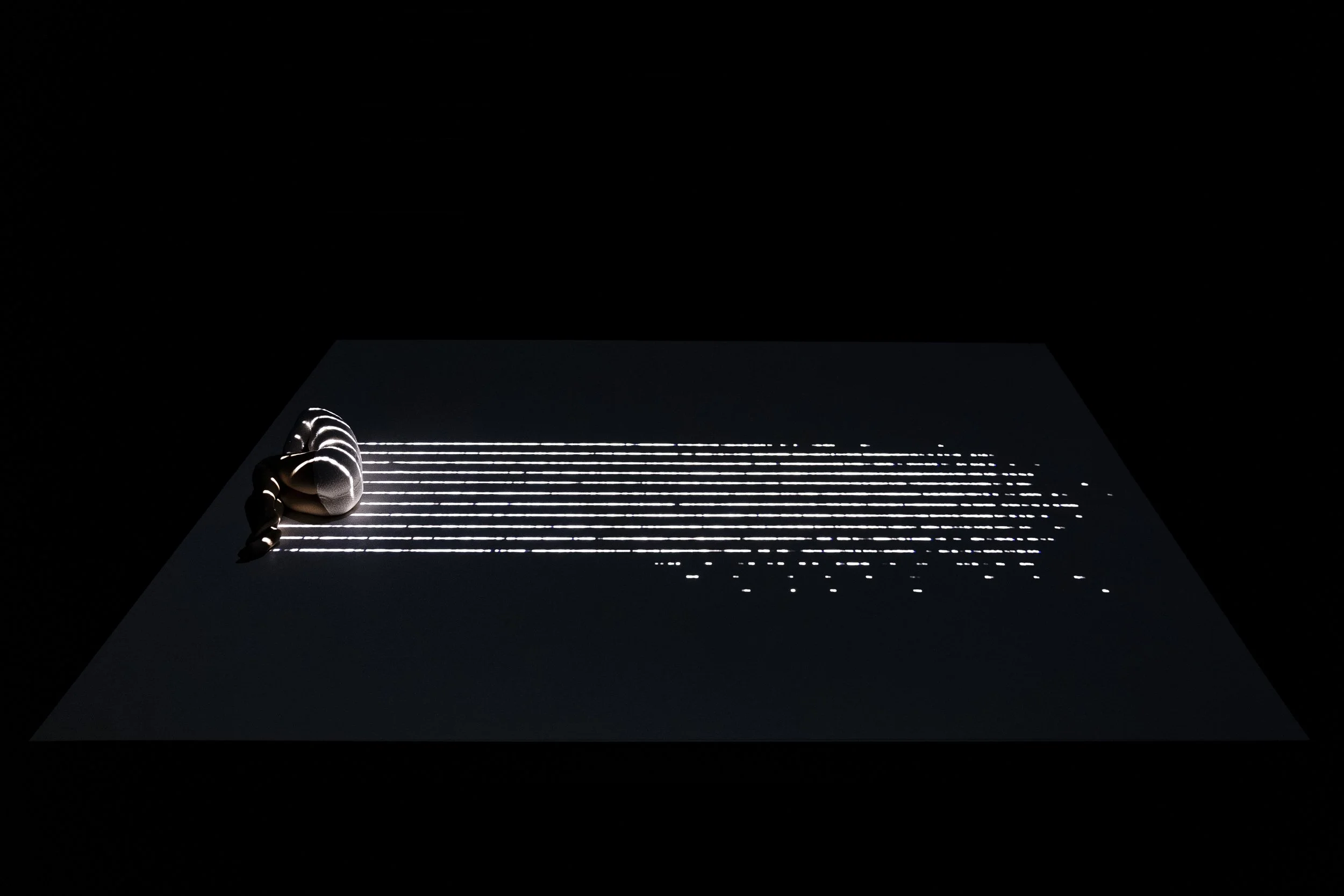
Finally, Melissa Pham’s interpretation introduced a deeply disciplined and kinetic velocity to the white square. Pham’s movement was defined by a hyper-crisp dynamism so rapid that she appeared to outrun the tracking algorithms, forcing the data projection to chase her silhouette across the floor. Pham, once again, revealed herself as a remarkably serious and refined performer who was able to discover unexpected pockets of room within the choreography while maintaining an impactful, deadpan affect. Her structural control allowed her to convincingly negotiate the work's inherent friction. She appeared to subtly tussle with the struggle of being possessed without ever veering into the over-the-top, rendering a physical fatigue that felt entirely believable and earned, despite her immense fitness.
Ultimately, the power of Glow in 2026 does not lie in its ability to shock us with new technology; we are far too far gone into the era of ubiquitous surveillance to be awed by simple infrared tracking. Its power lies in its function as a monument to a specific threshold, operating on a universal, evolutionary arc that required no cultural or linguistic translation to traverse global cultural spaces. The joint venture forged between a moving body and tracking light ultimately reveals itself as flawed and irreconcilable, leaving us with an enduring somatic provocation: even when the system tries to flatten, track, and contain us, the body will always find a way to thrash, sweat, and push its way back to the surface.
References
Adnan, Etel, The Beauty of Light: Interviews by Etel Adnan and Laure Adler. Paris: Galerie Lelong, 2011; English trans. Nightboat Books, 2024.
Weiss, Frieder, ‘Glow’ Concept Statement, accessed via frieder-weiss.de.
Preciado, Paul B, Can the Monster Speak?: A Report to an Academy of Psychoanalysts, London: Fitzcarraldo Editions, 2021.
Adnan, Etel, Time, Post-Apollo Press, 2003.
Isabella Hone-Saunders is a curator, arts worker and artist living in Naarm/Melbourne. Their broader practice is concentrated on amplifying community and socially engaged practices and supporting artists in taking creative risks. The research projects Hone-Saunders has curated explore themes of habitat sharing, survival and extraction, to consider the interplay between human, animal, and ecological well-being. Currently, they hold the role of Assistant Curator, Art Museums, the University of Melbourne. Formerly working as the Director of Seventh Gallery, also having held curatorial positions at the Australian Centre for the Moving Image (ACMI) and the Australian Centre for Contemporary Art (ACCA). Hone-Saunders holds a Master of Art Curatorship from the University of Melbourne and is a current PhD candidate in Curatorial Practice at Monash University. The core concept of Isabella’s PhD research proposes hope as a generative and disciplined curatorial methodology and as a type of active recommitment that reorients despair and has the potential to cultivate new forms of solidarity.